
In Which I Accuse Myself of Hypocrisy and Then Argue My Way Out
I’ve spent a good chunk of my professional life explaining to importers why tariffs are a bad idea. They’re inflationary. They’re regressive (meaning they hit people with less money harder than people with more money). And in the current environment, they’re being deployed with all the surgical precision of a leaf blower in a library.
You can imagine my discomfort when I caught myself thinking: “Good. Stick it to Russia.” I actually said something else instead of “stick it.” Because Ukraine, Georgia, etc.
Let me explain the contradiction and then try to explain my way out of it. Feel free to disagree.
My Positions, Stated Plainly
Position 1: I oppose tariffs as economic policy. The Section 301 tariffs on China, the Section 232 steel, aluminum, and automotive tariffs, the IEEPA tariff blizzard currently pelting importers… I think these are bad policy. They raise costs, distort supply chains, and ultimately get paid by American businesses and consumers, not by the foreign exporters everyone seems to think are footing the bill. But here is the question that started nagging at me: when do they go away?
Position 2: I support antidumping and countervailing duties (AD/CVD). When I teach tariff classification, I use a mixed martial arts analogy, because many people assume that in MMA, anything goes. Not true. In MMA, you cannot strike your opponent in the family jewels. Likewise in boxing, you cannot bite your opponent (see below). There are rules. One of the rules in international trade is “do not dump.” AD/CVD is the referee enforcing that rule. I’m fine with that. Stop dumping, demonstrate it, and the antidumping duty goes away. That’s the point.
Position 3: I support the Column 2 duty rates for Russia and Belarus. Column 2 of the Harmonized Tariff Schedule of the United States (HTSUS) contains the old pre-WTO duty rates. Think the Smoot-Hawley Tariff Act of 1930, which I have exactly zero nostalgia for. Most countries get the much lower Column 1 most-favored nation/normal trade relations (MFN/NTR) rates. Russia and Belarus, following their respective misadventures in Georgia and Ukraine, got bumped to Column 2. Yay. Congress finally did something I agree with. Russia knows what it must do to get back to Column 1. Whether it will is another matter.
Then it hit me, and I was stumped.
The Uncomfortable Question
If I oppose tariffs as a policy tool, how can I cheer when Russia gets hit with Column 2 rates? And while I’m at it, how can I support economic sanctions on Cuba, Iran, and Russia (which are, at their core, trade restrictions) while objecting to tariffs?
I sat with this for a while. It bothered me. I don’t like discovering that my principles have exceptions I haven’t thought through. I felt intellectually dishonest.
My four-year-old asked: “Daddy, if Trump simply wanted to punish countries he doesn’t like, couldn’t he have just moved them to Column 2?” Tidy, statutory, precedented. Answer: no, kiddo, he can’t. Column 2 changes require an act of Congress. Granting or revoking NTR status is a congressional function. The President doesn’t get to redecorate the HTSUS.
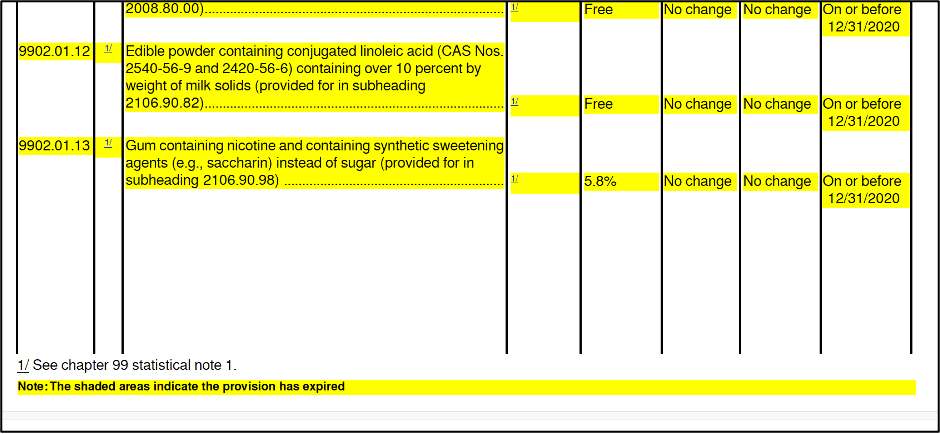
(OK, he redecorates by mangling Chapter 99—have you ever seen so much gold leaf—I mean, have you ever seen hundreds of pages of yellow highlighting? It’s better than hundreds of pages of redactions. But, Column 2 is out of reach.)
That answer, while correct, doesn’t fully resolve the philosophical tension. Here’s how I (think I) resolved it.
The Resolution: Process Legitimacy Matters
The key distinction isn’t the outcome. It is how you got there.
Consider homicide: self-defense, manslaughter, and murder all result in someone dead. Dead, dead, dead. The legal and moral distinction is entirely about intent and process. Same outcome, completely different character.
The means don’t just matter. They define us.
Column 2 rates exist because Congress put them there. They’re applied through a transparent (or so we tell ourselves) rules-based framework. Countries exit Column 2 through a defined process: Congress grants NTR status, and they’re in. AD/CVD duties exist because an investigation, with evidence, hearings, and legal standards, determined that someone cheated. Sanctions exist as foreign policy instruments with multilateral dimensions, legal frameworks, and stated objectives.
What I oppose is the other thing: executive branch tariff policy deployed without predictable criteria, applied to allies and adversaries alike, justified by trade deficit math (which is not a rules violation), and revocable based on whatever happened at the last summit. The IEEPA tariffs. The 301 tariffs. The 232 expansions that somehow turned dishwashers (and cabinetry!) into national security threats.
I paraphrase Monty Python’s Knights Who Say Ni: “Bring me… a cab-i-ne-try!”
I can support a mechanism in which Congress sets punitive rates for countries that don’t play by the rules, while opposing the executive branch improvising tariff policy by tweet (PBT). These are not the same thing wearing different hats. Don’t get me started on hats.
Think of it this way: a speeding ticket is legitimate even if you think the speed limit is too low. A cop who makes up rules on the side of the road is not. Same outcome (you’re paying), completely different legitimacy. And at the end of this, see my unrelated commentary on stop signs and recordkeeping (or record keeping).
Where the Tension Doesn’t Fully Resolve
I’ll be honest about the residual discomfort, because intellectual honesty requires it.
Supporting Column 2 for Russia on geopolitical grounds (because they invaded Georgia and Ukraine) while opposing IEEPA tariffs on China for national security or geopolitical reasons is a thinner distinction than the procedural argument suggests. If I’m comfortable with “Congress can punish countries geopolitically via tariffs,” someone can reasonably ask why I’m uncomfortable with the executive branch doing something similar.
The cleanest answer I can give: I’m not opposed to the goal in every case. I’m opposed to the instrument and the scope. A scalpel and a chainsaw can both remove a tree branch. One of them is the right tool.
Bottom Line
Am I a hypocrite? I don’t think so, but I understand why the question arises. My positions cohere around process legitimacy and rules enforcement, not outcomes. I support trade restrictions when they’re enacted through proper legal channels, based on adjudicated violations or congressional judgment, with defined criteria and off-ramps.
The off-ramps matter more than people realize. Column 2 has them because the cause is clear: reverse the conduct, and Russia earns its way back to NTR status. The 301, 232, and IEEPA tariffs? No off-ramps. No defined endpoint. No reversible condition. Just tariffs, indefinitely, until someone in the executive branch decides otherwise.
To use military parlance: there is action, but there is no mission.
What I oppose is tariff policy as improvisation. As leverage. As punishment without process.
When I went to business school, I was taught every business plan required an exit strategy. The big two were: sell the business or go public. There is no exit strategy with these tariffs, and that is a fatal flaw.
Going back to the MMA analogy: there are rules about how you fight, not just whether you fight. I’m not a pacifist. I just think the ref matters. In boxing, biting is not allowed. And if Iron Mike is going to bite someone’s ear off, he must ask first.
Unrelated commentary on stop signs and record keeping
Everyone has that one stop sign in their neighborhood they know they can roll through without getting caught. Technically wrong, but no harm, no foul, right? When it comes to trade violations, the record keeping statute ensures that regulators can see every stop sign you’ve rolled through for the last five years. Yikes. Do not destroy your records, and don’t store them in the bathroom.
Pic of yellow highlighting below for attention.
Arthur “Ni” O’Meara is the founder and principal of O’Meara & Associates, a global trade training and consulting firm. He has been explaining international trade to practitioners for roughly three decades, and catching contradictions in his own thinking for the same amount of time.
Read Other Latest Posts
Posted in Global Trade, Harmonized Tariff Schedule